




What Happens to Cobalt Binder When Snow Plow Blades Hit 300°C Friction Heat?
When snow plow blades reach 300°C from friction, the cobalt binder in traditional carbides softens, forms brittle eta-phases, and delaminates from tungsten carbide particles, causing rapid failure. SENTHAI's vacuum-sintered micro-grain tungsten carbide blades maintain…
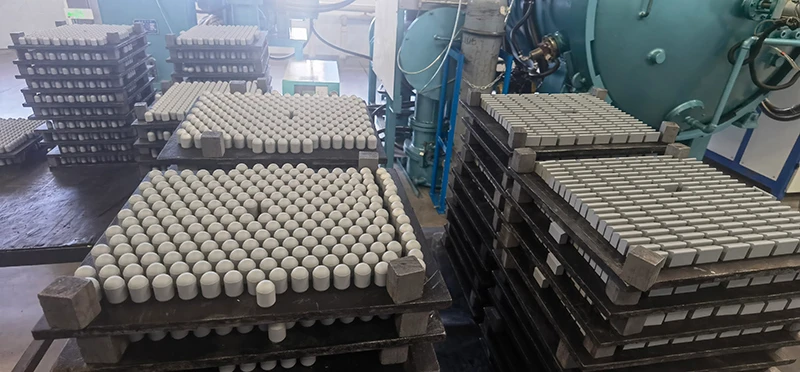
When snow plow blades reach 300°C from friction, the cobalt binder in traditional carbides softens, forms brittle eta-phases, and delaminates from tungsten carbide particles, causing rapid failure. SENTHAI’s vacuum-sintered micro-grain tungsten carbide blades maintain strong bonding and resist phase transitions for extended durability.
Check: How Does Cobalt Strengthen Tungsten Carbide for Snow Plow Blades?
How Does Cobalt Binder Fail in Traditional Snow Plow Carbides?
Cobalt binder fails above 280-300°C as it softens, losing hardness and toughness during high-friction plowing. This triggers eta-phase formation, creating brittle structures that delaminate carbide particles from the steel body, leading to cracking, particle loss, and premature blade replacement with costly downtime for fleets.
Why Does Friction Heat Reach 300°C in Snow Plow Blades?
Friction heat hits 300°C from high-speed scraping of ice, asphalt, and concrete, converting kinetic energy to localized surface heat. Repeated plowing passes accumulate thermal buildup, especially in urban routes with braking, while impacts from debris cause temperature spikes that stress the cobalt binder.
What Is Cobalt Phase Transition and How Does It Degrade Carbide?
Cobalt phase transition disrupts the binder’s lattice structure at 280-350°C, forming brittle eta-phases that weaken metal-to-ceramic bonds. This allows tungsten carbide particles to dislodge under vibration and impact, exposing steel to wear and causing blade failure within 50-100 hours.
| Cobalt Phase State | Temperature Range | Material Behavior | Impact on Snow Plow Blades |
|---|---|---|---|
| Alpha-cobalt (stable) | <427°C | High hardness, ductile binder | Optimal cutting; maintains bonding |
| Eta-phase formation | 280–350°C | Brittle, reduced toughness | Delamination; micro-cracking |
| Severe binder softening | 350°C+ | Loss of integrity | Binding failure; blade shatters |
How Does SENTHAI’s Vacuum Sintering Prevent Cobalt Phase Shifts?
SENTHAI’s vacuum sintering in Rayong, Thailand, creates uniform cobalt grain structure and high-density binding, eliminating porosity that accelerates failure at 300°C. Micro-grain tungsten carbide from wet grinding ensures tight interfaces, resisting delamination during thermal stress in fully automated production lines.
SENTHAI Expert Views
After 21 years in carbide production, we engineered vacuum sintering protocols specifically for snow plow friction demands. Our Thailand in-house control—from raw powder to final vulcanization—ensures cobalt binder density and thermal uniformity that competitors cannot match. ISO 9001/14001 testing confirms zero eta-phase formation in blades exposed to extended plowing cycles with 300°C+ friction spikes.
What Testing Proves SENTHAI Blades Resist High-Temperature Cobalt Failure?
SENTHAI’s ISO 9001/14001 protocols include thermal-cycling tests simulating 300°C+ shocks, verifying no delamination. Real-world data from 80+ global partners shows 85% efficiency after 500 hours versus 40-60% loss in competitors. In-house sintering ensures bonding strength for North American fleets.
Which SENTHAI Blade Types Best Handle 300°C Friction Heat?
SENTHAI’s I.C.E. Blades isolate tungsten carbide inserts to prevent cracking at 300°C. JOMA Style Blades, with 48″ x 6″ x 7/8″ sizes and carbide inserts brazed into cast steel segments encased in rubber, distribute heat effectively. Carbide Blades with tungsten cladding offer 10x lifespan in extreme conditions; customization available from MOQ 500.
Check: Carbide Inserts
| Blade Type | Key Heat-Resistant Feature | Size Example | Applications |
|---|---|---|---|
| I.C.E. Blades | Isolated inserts prevent cracking | Custom | High-speed, uneven roads |
| JOMA Style | Rubber-encased steel segments | 48″ x 6″ x 7/8″ | Highways, urban plowing |
| Carbide Blades | Tungsten cladding on steel | Various sizes | Heavy-duty maintenance |
How Do Eco-Friendly Manufacturing and Material Recovery Enhance Heat Resistance?
SENTHAI’s ISO 14001-compliant Rayong facility uses energy-efficient sintering to minimize thermal defects, improving cobalt uniformity. In-house scrap recovery ensures virgin micro-grain carbide purity, strengthening binders against 300°C. The new 2025 Rayong base expands capacity for advanced protocols.
What’s the Cost-Benefit of Investing in Heat-Resistant Carbide vs. Steel Blades?
SENTHAI carbide blades last 10x longer than steel despite 300°C heat, reducing replacements and downtime. Fleets save on maintenance, fuel, and road damage from failures. Higher upfront cost yields fast ROI through efficiency, trusted by North American municipal plows and contractors.
Conclusion
Cobalt binder phase transitions at 300°C drive failure in traditional snow plow blades, causing delamination and high costs. SENTHAI’s vacuum-sintered JOMA Style Blades, I.C.E. Blades, Carbide Blades, and inserts—produced in Thailand with 21+ years expertise—eliminate this risk. With ISO certifications, 80+ partners, and 10x lifespan, they deliver durability for winter maintenance. Explore SENTHAI’s options and request samples today.
FAQs
Can I use standard steel blades if I maintain lower friction temperatures?
No. Snow plow friction routinely reaches 200-300°C. Steel lacks thermal stability of SENTHAI’s vacuum-sintered carbide with engineered cobalt binders for extreme heat.
How often should I replace SENTHAI carbide blades to prevent cobalt phase-shift failure?
SENTHAI blades last 500+ hours without phase shifts. Replace based on edge wear—3-5x longer than steel. ISO testing confirms integrity.
Are SENTHAI’s I.C.E. Blades better for high-friction routes than JOMA Style?
I.C.E. isolates particles for impact-heavy urban routes; JOMA Style distributes heat via rubber for highways. SENTHAI customizes per fleet needs.
What warranty or testing documentation proves heat resistance?
SENTHAI provides ISO 9001/14001 reports, bonding certifications, and fleet data. Request samples and QC reports for your blade sizes.
Can SENTHAI scale production for 5,000+ blades for winter 2026-27?
Yes. MOQ 500 with automated Thailand lines. New Rayong facility launching late 2025 expands for large orders; contact for quotes.
Related articles
 Best Snow Plow Blade Family for Your Fleet: Top 5 ScenariosKnowledge
 Top 10 Snow Plow Blade Types for Winter Fleets (Ranked by Duty Fit)Knowledge
 Top 5 Best Carbide Blade Configurations for Highway PlowingKnowledge
 Best Snow Plow Blade Materials Ranked: Steel vs Carbide vs Cladding vs Rubber-CarbideKnowledge