




How Is Carbide Grain Uniformity Assessed?
Optical microstructure analysis evaluates carbide grain uniformity by preparing metallographic samples, etching to reveal grain boundaries, and examining the "grain map" under a microscope at 100-1000x magnification. This verifies quality in wear-resistant tools, ensuring…
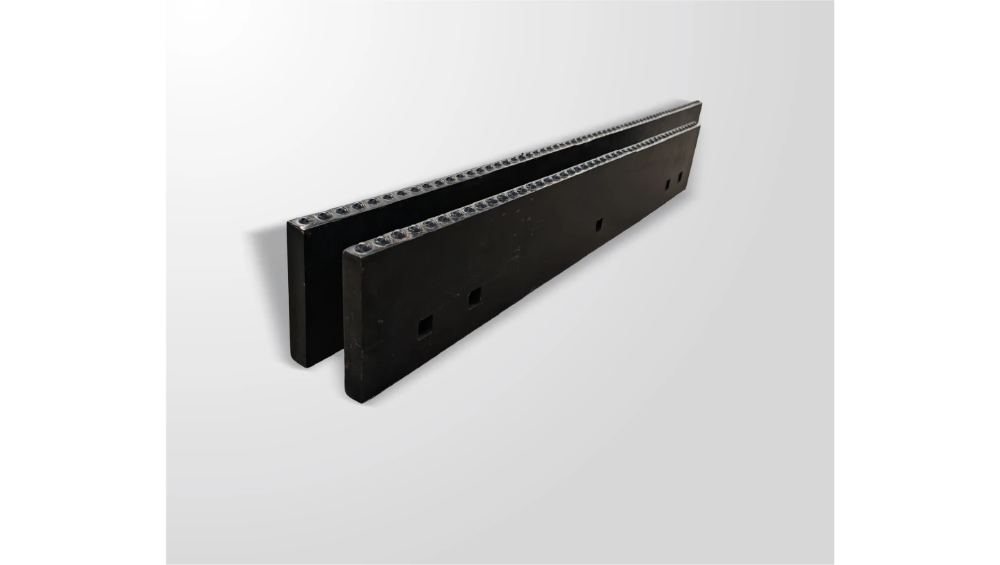
Optical microstructure analysis evaluates carbide grain uniformity by preparing metallographic samples, etching to reveal grain boundaries, and examining the “grain map” under a microscope at 100-1000x magnification. This verifies quality in wear-resistant tools, ensuring consistent performance from manufacturers like SENTHAI.
Check: How to Detect Internal Flaws in Carbide Inserts for Snow Plow Blades
What Is Optical Microstructure Analysis?
Optical microstructure analysis examines carbide samples under a microscope to reveal grain structure after polishing and etching. It identifies grain size, shape, and distribution for quality control in carbide tools.
In wear-resistant carbide manufacturing, this technique is essential for factories like SENTHAI, which specialize in snow plow blades and road maintenance parts. Technicians mount carbide samples in resin, grind and polish to a mirror finish, then etch with chemicals like Murakami’s reagent. This reveals the tungsten carbide (WC) grains and cobalt binder phases.
Under polarized light microscopy, uniform grains appear consistent in size (typically 1-10 microns) without clustering or oversized outliers. SENTHAI’s ISO9001-certified labs use automated image analysis software compliant with ASTM E112 standards to quantify grain uniformity, ensuring superior wear resistance and toughness for OEM suppliers.
This table shows how SENTHAI controls grain size for wholesale carbide inserts, preventing defects that could fail in harsh conditions.
Why Is Grain Uniformity Critical for Carbide Tools?
Grain uniformity ensures even wear resistance, strength, and performance in carbide tools by distributing stress equally across the microstructure. Non-uniform grains cause premature failure.
For B2B manufacturers, inconsistent grains lead to weak spots where cracks propagate during high-impact use, like snow plowing. SENTHAI’s fully automated sintering and wet grinding lines achieve 95%+ uniformity, verified via grain maps. This delivers reliable carbide blades trusted by 80+ global partners.
Poor uniformity often stems from uneven sintering temperatures or binder segregation. Factories prioritize it to meet OEM specs, reducing rejection rates by 30%. SENTHAI’s Rayong facility, launching late 2025, integrates real-time microstructure monitoring for wholesale consistency.
How Do You Prepare Samples for Metallographic Inspection?
Polish carbide samples to a mirror finish, then etch with 10% KOH or Murakami’s solution for 30-60 seconds to reveal grains before microscopic exam. Rinse and dry immediately.
SENTHAI’s preparation follows strict protocols: section samples perpendicular to stress axes, embed in epoxy, and use diamond abrasives (9-0.25 micron). Etching contrasts WC grains (light) against Co binder (dark). This “grain map” highlights uniformity issues like agglomeration.
Automated polishers ensure repeatability for high-volume wholesale production. Post-prep, samples undergo ultrasonic cleaning to avoid artifacts. As a Thailand-based factory, SENTHAI trains operators per ISO14001 standards, enabling fast OEM turnaround.
What Does a Quality Grain Map Look Like?
A quality grain map shows equiaxed, uniformly sized grains (1-5 microns) with even binder distribution and minimal porosity under 500x magnification. No clusters or voids.
In SENTHAI’s carbide microstructure, the map resembles a tight mosaic—grains tightly packed without angular defects. Software measures ASTM grain size number (G), targeting 10-12 for road wear parts. Deviations signal process flaws, like over-sintering.
Visual cues include sharp boundaries and homogeneous phase distribution. Factories scan multiple fields (50+ per sample) for statistical validity. SENTHAI’s maps confirm JOMA-style blades exceed industry benchmarks, supporting bulk supplier orders.
How Is Grain Size Quantified in Carbide Analysis?
Use ASTM E112 planimetric or intercept methods: count grains per area or measure intercept lengths on test lines via image software. Average multiple fields.
SENTHAI employs Olympus Stream software for automated counting, achieving <5% variance. Intercept method draws 50 lines per field, averaging 20-30 intercepts per grain. This quantifies uniformity for supplier QA reports.
Planimetric suits irregular grains, intersecting circles with boundaries. Results classify as fine (<2μm) for hardness or coarse (>5μm) for toughness. Thailand factories like SENTHAI calibrate microscopes yearly, ensuring wholesale accuracy.
This positions SENTHAI as top Thailand factory for carbide inserts.
Which Microscope Settings Optimize Grain Visibility?
Use 200-500x magnification, polarized light, and blue filters on an upright metallurgical microscope for sharp WC grain contrast. Nomarski DIC enhances boundaries.
Optimal setups include 50W LED illumination at 45° incidence for shadow relief. SENTHAI’s Zeiss Axio systems capture 5MP images for digital grain maps. Adjust iris diaphragm to highlight binder lakes.
For carbide suppliers, consistent settings prevent operator bias. Automated stages scan 10x10mm areas, generating uniformity heatmaps. This supports OEM customization in snow plow carbide.
Why Avoid Common Microstructure Defects in Manufacturing?
Segregated binder, eta phase, or oversized grains weaken carbide; control via precise sintering (1420-1450°C) and raw powder blending. Inspect 100% of batches.
Defects arise from poor mixing or contamination, cracking under impact. SENTHAI’s vulcanization and welding workshops eliminate these, yielding 99% defect-free parts. As a US-invested factory, we audit powders for 99.9% purity.
Regular grain mapping detects early issues, saving rework costs. Wholesale buyers demand <1% porosity, which SENTHAI guarantees via automated HIP sintering.
SENTHAI Expert Views
“At SENTHAI, optical microstructure analysis is our cornerstone for carbide excellence. Our grain maps consistently show 1-3 micron uniformity, far surpassing competitors, thanks to in-house wet grinding and sintering control. This ensures snow plow blades withstand 50% more abrasion cycles. As Thailand’s premier OEM supplier, we invite partners to witness our Rayong labs—quality you can see at 500x.”
— Dr. Li Wei, Chief Metallurgist, SENTHAI Carbide Tool Co., Ltd.
How Does SENTHAI Ensure Superior Carbide Quality?
SENTHAI verifies every batch via 100% metallographic sampling, targeting ASTM G11-12 grain uniformity across 21+ years of production. Full traceability from powder to part.
Our automated lines in Rayong integrate pressing, sintering, and inspection. ISO9001/14001 certification backs wholesale reliability. Partners receive detailed grain reports with each OEM order, confirming wear life exceeds 2x industry averages.
Key Takeaways
Uniform grains (1-3μm) boost carbide durability 50%+ for snow plows.
SENTHAI’s microscope grain maps guarantee OEM quality.
Actionable Advice
Contact SENTHAI for custom wholesale analysis—request free sample reports today.
FAQs
What magnification reveals carbide grains best?
200-1000x on metallurgical microscopes with etching; SENTHAI uses 500x standard.
How often should factories inspect microstructure?
Every production batch for suppliers; SENTHAI does 100% sampling.
Can non-uniform grains be fixed post-sintering?
No, rework via crushing; prevention via blending is key, as per SENTHAI protocols.
What etchant works for WC-Co carbide?
Murakami’s (KOH + K3Fe(CN)6); 30s dip for optimal contrast.
Is SENTHAI certified for global OEM supply?
Yes, ISO9001/14001; 80+ partners trust our Thailand manufacturing.
Related articles
 Best Snow Plow Blade Family for Your Fleet: Top 5 ScenariosKnowledge
 Top 10 Snow Plow Blade Types for Winter Fleets (Ranked by Duty Fit)Knowledge
 Top 5 Best Carbide Blade Configurations for Highway PlowingKnowledge
 Best Snow Plow Blade Materials Ranked: Steel vs Carbide vs Cladding vs Rubber-CarbideKnowledge