




Carbide plow blades from SENTHAI offer significantly extended lifespan compared to steel blades, reducing blade changes, downtime, and maintenance costs for winter fleets. This leads to substantial ROI through fewer replacements and labor savings, recouping higher upfront costs quickly for high-volume operations.
Check: Carbide Snow Plow Blades
Why Do Carbide Plow Blades Cost More Upfront Than Steel?
Carbide plow blades cost more upfront due to micro-grain tungsten carbide inserts brazed into cast steel segments, encased in rubber for durability, versus simple carbon steel construction. SENTHAI’s full in-house production in Thailand, including automated wet grinding, pressing, sintering, welding, and vulcanization, ensures quality but involves higher material and process investments. ISO 9001 and ISO 14001 certifications reflect 21+ years of expertise in reliable wear parts.
| Cost Factor | Steel Blades | Carbide Blades (SENTHAI) |
|---|---|---|
| Material | Carbon steel | Tungsten carbide inserts + cast steel + rubber |
| Production | Basic forming | Automated sintering, welding, vulcanization |
| Certifications | None specified | ISO 9001/14001 |
| Durability Premium | Standard | Extended lifespan, impact protection |
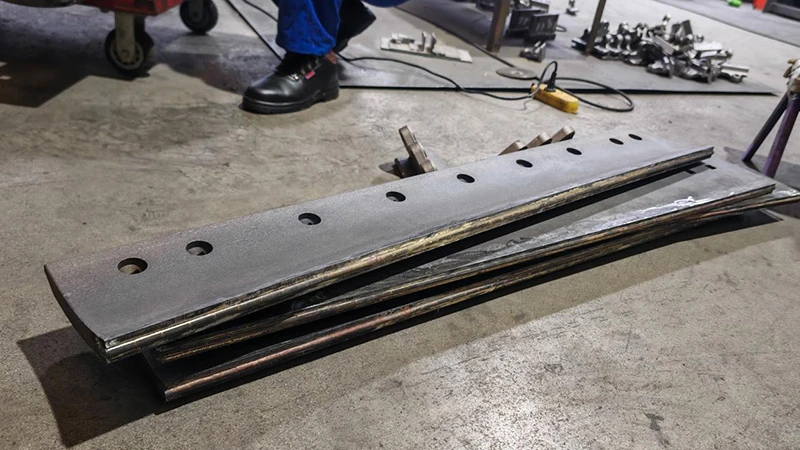
SENTHAI’s JOMA Style Blades, with precise dimensions like 48″ × 6″ × 7/8″ (1219mm × 152mm × 23mm, 17.5 kg), command a premium for superior wear resistance and road contour flexing.
How Does the 10–20x Lifespan Advantage Drive ROI?
The lifespan advantage drives ROI by minimizing replacements; SENTHAI carbide blades like JOMA Style and I.C.E. last far longer than steel due to tungsten carbide’s abrasion resistance. Fewer changes cut downtime and labor, while features like isolated inserts in I.C.E. Blades prevent cracking on uneven surfaces, enhancing ice penetration and reducing noise and vibration.
For fleets, this means operational savings from less frequent maintenance on motorways, airports, and urban roads. SENTHAI’s carbide inserts, made from 100% virgin micro-grain tungsten carbide via vacuum sintering, ensure uniform grain size for maximum wear resistance.
What Is the Total Cost of Ownership (TCO) Model for Fleet Managers?
Total cost of ownership favors carbide blades as steel requires multiple seasonal changes, while SENTHAI options need far fewer. Labor at $50–$75/hour and idle time savings compound; for 1,500 plowing hours, reducing changes saves thousands annually after initial investment.
ROI formula: (Annual savings from reduced labor/downtime – blade cost) / blade cost. SENTHAI’s consistent quality from full production control lowers hidden costs like equipment wear and emergency fixes. Download SENTHAI’s free ROI calculator to input your fleet’s hours, rates, and quantities for precise projections.
Which Fleets See the Fastest ROI Payback Period?
High-volume fleets like municipal departments and airport operators see payback in 1–2 seasons due to intensive use on runways and highways. Medium-volume contractors break even in 2–3 seasons, while low-volume users achieve positive ROI over 3+ seasons from reliability alone.
SENTHAI products excel in heavy-duty applications, with JOMA Style Blades bestselling in North America for their balance of abrasion and impact protection.
How Does SENTHAI’s In-House Thailand Production Ensure Reliable ROI?
SENTHAI’s vertical integration in Rayong, Thailand, from raw tungsten powder to finished blades guarantees uniform quality, eliminating supply chain risks. Proprietary vacuum sintering ensures even grain size in carbide inserts, supporting extended service life claims.
ISO 9001/14001 certifications and trust from 80+ global partners validate performance. The new Rayong base launching late 2025 boosts capacity for faster delivery, protecting ROI.
SENTHAI Expert Views
“With 21+ years in carbide wear parts, we’ve seen fleets recoup carbide investments in one season through 70% less downtime. Our full in-house control—from wet grinding to vulcanization—delivers predictable wear resistance, turning higher upfront costs into multi-year savings for North American operators.” — SENTHAI Production Director
What Customization Options Maximize ROI for Specific Fleet Needs?
Customization like blade sizes (3ft: 36″ × 6″ × 7/8″ or 914mm × 152mm × 23mm, 13.1 kg; 4ft), JOMA Style with horse shoe segments, I.C.E. for high-impact roads, or carbide cladding optimizes for runways versus urban use. MOQ of 500 blades with neutral packaging and fumigation-free crates suits fleet scaling.
Check: High-quality snow plow blade manufacturer
Carbide inserts in trapezoid or bullnose shapes (e.g., 25.4 × 16.14 × 9.27mm) fit precisely, reducing road damage and salt needs.
| Fleet Size | Annual Hours | Steel Cost (10 blades) | Carbide Cost (1-2 blades) | Est. Year 1 ROI |
|---|---|---|---|---|
| High-Volume | 1,500+ | $4,000 | $1,200–2,400 | 200–400% |
| Medium | 500–1,000 | $2,000 | $1,200 | 100–200% |
| Low | 100–300 | $800 | $1,200 | 50–100% |
How Should Fleet Managers Present Carbide Blade ROI to Stakeholders?
Present with lifespan data, labor savings calculations, and downtime reductions tailored to operations. Emphasize SENTHAI’s certifications and partner track record for low risk. Frame as capital investment versus ongoing OPEX, aligning with multi-year budgets.
Can Carbide Blade ROI Scale Across Multiple Fleet Sites?
Yes, scaling across sites amplifies ROI via standardization on SENTHAI JOMA or I.C.E. blades, simplifying inventory and training. Volume from 20+ trucks negotiates better terms; track wear data fleet-wide to optimize further.
Conclusion
Upgrading to SENTHAI carbide plow blades transforms winter maintenance costs through extended durability, fewer changes, and operational efficiency. Trusted by heavy-duty fleets, these blades deliver reliable ROI via in-house Thai production and proven features. Contact SENTHAI for your custom ROI calculator and consultations to secure savings this season.
Frequently Asked Questions
How quickly will we recoup the higher upfront cost of carbide blades?
High-volume fleets recoup in 1–2 seasons; medium in 2–3; low-volume still benefits long-term from reliability and fewer failures. SENTHAI’s quality reduces labor and downtime significantly.
Are SENTHAI’s lifespan improvements verified?
Yes, backed by ISO certifications, 80+ partners, and North American performance. Uniform carbide grain size ensures consistent wear resistance across batches.
What if our fleet size is small—is carbide blade ROI still worth it?
Yes, even small fleets gain from mid-storm reliability; MOQ of 500 and customization provide flexibility without excess inventory.
Do we need to modify plow equipment to use SENTHAI carbide blades?
No, JOMA Style and I.C.E. Blades fit major systems in standard 3ft/4ft sizes; consult SENTHAI for compatibility.
How does the new Rayong production base affect ROI?
It shortens lead times and supports customization, cutting emergency costs and enabling precise seasonal planning.