




Engineering the Weakest Point in Brazed Carbide Snow Plow Blades: Why the Bond Fails Before the Carbide
When brazed carbide snow plow blades fail in the field, it is rarely because the carbide itself wore out too quickly. The more common—and far more costly—problem is insert loss: carbide segments breaking free…
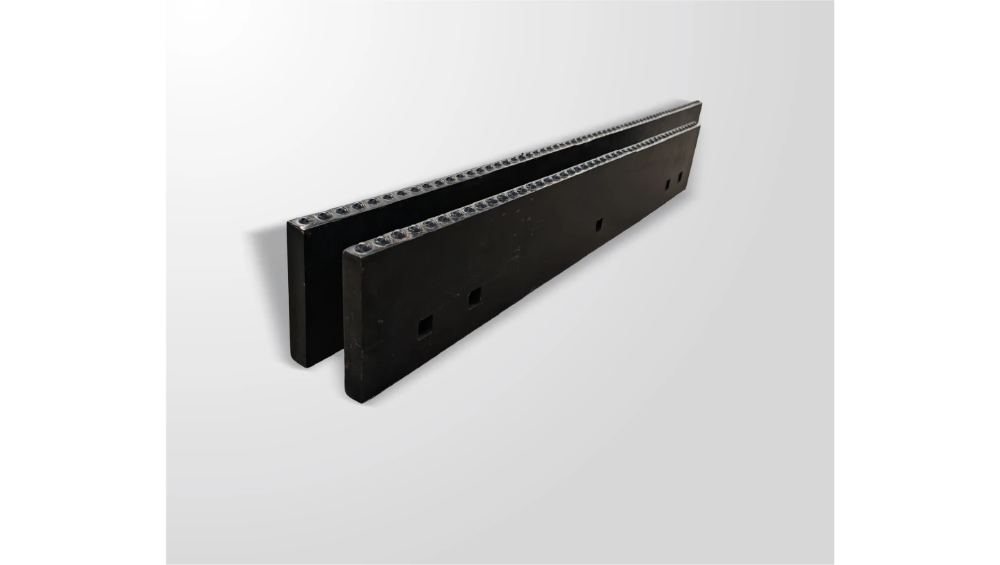
When brazed carbide snow plow blades fail in the field, it is rarely because the carbide itself wore out too quickly. The more common—and far more costly—problem is insert loss: carbide segments breaking free under shock, leaving uneven edges, vibration, and emergency blade changes mid-route. For highway crews, airport operations, and high-speed plowing fleets, that failure often traces back to a thin, nearly invisible layer—the brazed joint between carbide and steel. Understanding how that bond is formed, controlled, and verified is what separates a blade that survives impact from one that sheds inserts under pressure.
Where Failures Actually Start: The Brazing Seam, Not the Edge
A carbide insert is only as reliable as the interface that holds it in place. That interface must absorb:
-
Sudden shear forces from hitting expansion joints or frozen ridges
-
Thermal shock from sub-zero temperatures and friction heating
-
Differential expansion between steel base and carbide insert
Even when the carbide grade is appropriate, weak bonding can lead to:
-
Insert spalling (carbide pieces detaching)
-
Micro-cracking along the steel groove
-
Progressive loosening due to voids in the brazed layer
In practical terms, a blade may look intact at installation but begin losing inserts after only a few high-impact passes if the brazing process was inconsistent.
The Hidden Variables in Carbide Blade Brazing
Not all brazed carbide snow plow blades are produced with the same level of process control. Several often-overlooked factors directly influence bond integrity:
Groove Machining Precision
The slot where the carbide sits must be dimensionally consistent. If tolerances are uneven:
-
Brazing alloy cannot flow uniformly
-
Capillary action becomes inconsistent
-
Air pockets or voids can form
These voids become stress concentrators under impact.
Alloy Distribution and Wetting
Silver-based brazing alloys are commonly used because they balance ductility and strength. However:
-
Poor wetting leads to incomplete bonding surfaces
-
Excess filler can create brittle zones
-
Insufficient alloy reduces shear resistance
Uniform flow around the entire insert—not just beneath it—is critical.
Thermal Control During Heating
Manual torch brazing introduces variability:
-
Uneven heating creates localized weak zones
-
Overheating can degrade alloy properties
-
Underheating prevents proper bonding
Automated induction systems aim to control this precisely.
Manual vs. Automated Induction Brazing
This distinction is one of the most important evaluation points for procurement teams.
Manual brazing typically involves operator-dependent heat application. While workable for small batches, it introduces variability that is difficult to track across production runs.
Automated induction brazing, by contrast, uses controlled electromagnetic heating to deliver:
-
Consistent temperature profiles
-
Repeatable heating cycles
-
Uniform alloy flow
In industrial snow plow blade manufacturing, this consistency directly impacts how well inserts stay bonded during repeated impact events.
For buyers evaluating suppliers, this is not a minor production detail—it is a primary risk factor in long-term blade reliability.
You can see how this approach is applied in practice through carbide blade manufacturing processes such as automated induction welding, where controlled heating replaces operator variability.
Why Inserts Fall Out: A Practical Failure Breakdown
In field terms, insert loss usually comes down to a combination of the following mechanisms:
-
Voids in the brazing layer: trapped air weakens structural continuity
-
Cold joints: insufficient heat prevents proper metallurgical bonding
-
Residual stress: rapid or uneven cooling creates internal tension
-
Thermal mismatch fatigue: repeated expansion cycles weaken the interface
-
Shear overload: impact exceeds joint capacity due to poor bonding
Even when shear strength targets are theoretically high (often referenced around 70,000 PSI in ideal conditions), real-world performance depends heavily on process consistency rather than nominal material capability.
Cooling Control: The Step Most Buyers Never Ask About
One of the least discussed—but highly influential—stages is post-brazing cooling.
If cooling happens too quickly or unevenly:
-
Residual stress builds between carbide and steel
-
Micro-cracks can form in the steel substrate
-
Long-term fatigue resistance drops
More controlled cooling methods, such as managed atmosphere or staged cooling, are used to reduce these stresses. Buyers rarely request documentation on this step, yet it directly affects whether a blade survives repeated freeze-thaw impact cycles.
Procurement Reality: What to Ask Before You Specify Brazed Blades
For municipalities, contractors, and distributors writing RFQs or evaluating suppliers, focusing only on carbide presence is not enough.
A more reliable evaluation includes:
-
How is brazing performed: manual torch or automated induction?
-
How is alloy flow controlled and verified?
-
Are groove tolerances standardized and measured?
-
What non-destructive checks are used to detect voids?
-
Is batch traceability available for production runs?
-
How is cooling managed after brazing?
These questions shift the conversation from “carbide vs. steel” to “bond reliability under impact,” which is where most failures originate.
Where SENTHAI Fits in This Conversation
For buyers prioritizing consistent insert retention rather than just carbide presence, manufacturers with controlled brazing systems become relevant.
SENTHAI Tool operates as a carbide wear parts manufacturer focused on process stability—particularly in automated brazing, thermal control, and batch traceability. This type of setup is typically suited for:
-
Highway and airport fleets with high-speed plowing exposure
-
Municipal buyers writing stricter technical specifications
-
Distributors needing consistent product behavior across batches
-
OEMs integrating carbide edges into equipment designs
It may be less critical for low-speed or occasional-use operations where impact loads are limited and replacement cycles are less sensitive to insert loss.
If your procurement process requires deeper evaluation, it is reasonable to request technical specifications and custom brazing options before committing to a supplier, especially when compatibility, insert configuration, and mounting patterns must align with existing fleet equipment.
The Cost Misconception: Carbide Is Not the Expensive Part
A common assumption is that carbide itself drives blade cost and performance. In reality:
-
The carbide insert is only one component
-
The brazing process determines whether that insert stays functional
-
Poor bonding increases downtime, not just replacement frequency
From a seasonal operations perspective, a blade that loses inserts early can disrupt routing schedules, increase maintenance labor, and create inconsistent scraping performance.
Frequently Asked Questions
Why do carbide inserts fall out of snow plow blades?
Most insert loss is caused by weaknesses in the brazed joint rather than the carbide itself. Voids, uneven heating, poor alloy flow, or residual stress can reduce the bond’s ability to handle impact and thermal cycling.
Is automated induction brazing better than manual welding for plow blades?
Automated induction brazing is generally more consistent because it controls temperature and heating cycles precisely. Manual methods depend heavily on operator skill and can introduce variability across batches.
How can I evaluate brazing quality when sourcing blades?
Ask about process control, groove tolerances, alloy application, and inspection methods. Requesting batch traceability and understanding how cooling is managed after brazing can also provide insight into quality consistency.
Does higher carbide content guarantee better performance?
Not necessarily. Even high-quality carbide will fail prematurely if the bonding process is weak. The integrity of the brazed interface is often more critical than the carbide volume alone.
Are all brazed carbide snow plow blades suitable for high-speed operations?
No. High-speed plowing introduces significant impact forces, and not all brazing processes produce joints strong enough to handle that environment. Buyers should verify how the blades are manufactured before specifying them for such use.
Related articles
 Best Snow Plow Blade Family for Your Fleet: Top 5 ScenariosKnowledge
 Top 10 Snow Plow Blade Types for Winter Fleets (Ranked by Duty Fit)Knowledge
 Top 5 Best Carbide Blade Configurations for Highway PlowingKnowledge
 Best Snow Plow Blade Materials Ranked: Steel vs Carbide vs Cladding vs Rubber-CarbideKnowledge