




Carbide snow plow blades maintain rigid cutting geometry under impact because tungsten carbide inserts possess yield strength of 1,500–2,500 MPa—3–10 times higher than steel carriers (250–400 MPa). When steel deflects on contact with potholes or frost heave, carbide resists deformation, preserving edge sharpness and extending blade life 10–20 times longer than traditional steel edges. This metallurgical advantage directly reduces fleet downtime and winter maintenance costs.
Check: Which Plow Blade Wins: Carbide vs Hardened Steel?
What Is Yield Strength and Why Does It Matter for Plow Blades?
Yield strength is the stress point at which a material permanently deforms and stops returning to its original shape. For plow blades, high yield strength ensures rigidity, correlating directly to cutting efficiency and edge retention. Steel carriers typically offer 250–400 MPa, while carbide inserts reach 1,500–2,500 MPa, enabling carbide to withstand potholes, frost heave, and uneven pavement compression without losing performance.
How Does Steel Bend Under Impact While Carbide Stays Rigid?
Steel carriers flex on high-impact contact due to lower yield strength, causing deflection that alters cutting angles and reduces snow/ice removal efficiency, leading to premature dulling. Carbide’s crystalline lattice structure and molecular hardness prevent permanent deformation. Repeated impact cycles accelerate steel fatigue failure, while carbide maintains geometry through thousands of impacts with minimal deflection.
| Characteristic | Steel Plow Blade | Carbide Plow Blade |
|---|---|---|
| Yield Strength | 250–400 MPa | 1,500–2,500 MPa |
| Deflection Under 5-Ton Impact | Measurable flex (millimeters) | Negligible (microns) |
| Edge Geometry Retention | Loses cutting angle after 50–200 impacts | Maintains edge geometry through 2,000+ impacts |
| Fatigue Failure Risk | High (repeated bending cycles) | Minimal (rigid structure resists cycling stress) |
| Service Life Advantage | Baseline (1x) | 10–20x longer than steel |
How Does SENTHAI’s Manufacturing Process Ensure Carbide Rigidity and Impact Resistance?
SENTHAI ensures carbide rigidity through full in-house production from raw tungsten carbide powder via wet grinding, pressing, vacuum sintering, welding, and vulcanization. Vacuum sintering achieves uniform grain size for consistent yield strength. ISO 9001 and ISO 14001 certifications guarantee precision at every stage, backed by 21+ years of expertise trusted by 80+ global partners in harsh winters.
Check: Carbide Snow Plow Blades
What Types of SENTHAI Carbide Blades Are Optimized for Maximum Impact Resistance?
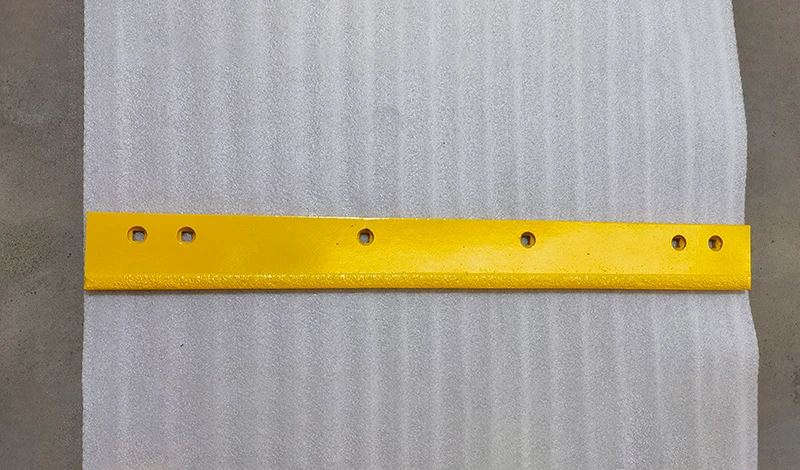
SENTHAI’s JOMA Style Blades feature tungsten carbide inserts brazed into cast steel segments encased in ultra-low-temperature-resistant rubber for vibration damping and deflection protection, available in 3-foot (36″ × 6″ × 7/8″) and 4-foot (48″ × 6″ × 7/8″) sizes. I.C.E. Blades use isolated tungsten carbide inserts to prevent lateral cracking under high-speed impacts on uneven surfaces.
- JOMA Style: Horse shoe cast steel segments with 1″ × 0.95″ × 0.32″ carbide inserts for balanced abrasion and impact resistance.
- I.C.E. (Packed Ice Carbide Kit): Isolated inserts ideal for roads with joints, cracks, lasting up to 3× longer in impact conditions.
- Full customization for sizes, designs, and packaging.
How Does Carbide Rigidity Reduce Total Cost of Ownership for Municipal and Fleet Operations?
Carbide rigidity extends service life 10–20x over steel, reducing replacement cycles from 5–10 to 0.5–1 per plow over five years. This minimizes downtime from 40–60 hours to 5–10 hours per season. SENTHAI’s 100% Thailand manufacturing and MOQ of 500 blades enable fast lead times and fleet standardization, yielding 40–60% lower cost per hour of operation.
| Cost Factor | Steel Blade Strategy | Carbide Blade Strategy |
|---|---|---|
| Blade Lifespan Per Unit | 1–2 seasons (500–1,000 hours) | 10–20 seasons (5,000–10,000 hours) |
| Replacement Cycles (5 years) | 5–10 replacements per plow | 0.5–1 replacement per plow |
| Downtime Hours Per Season | 40–60 hours (mid-season swaps) | 5–10 hours (maintenance only) |
| Operational Efficiency Loss | 15–25% blade degradation mid-season | <5% efficiency loss over full lifespan |
| Estimated 5-Year Cost (per plow) | $2,500–$4,000 (blades + labor) | $3,500–$4,500 (initial + minimal replacement) |
| Cost Advantage | Baseline | 40–60% lower true cost per hour |
Why Do North American Fleets Prefer SENTHAI’s Carbide Blades for Harsh Winter Conditions?
North American fleets prefer SENTHAI blades as bestsellers trusted by heavy-duty and municipal operations for rigidity in extreme cold, where carbide resists thermal stress unlike steel. Proven on asphalt, concrete, gravel, and frost-heave roads. SENTHAI’s OEM customization, ISO certifications, and new Rayong base launching late 2025 ensure reliable performance for 80+ global partners.
Can Carbide Blades Be Customized for Specific Fleet Equipment and Road Conditions?
Yes, SENTHAI offers full OEM customization including blade geometry, sizes like 3ft or 4ft JOMA Style, carbide insert shapes (trapezoid or bullnose), mounting patterns, and load optimization. In-house R&D and automated lines enable fast cycles. Fleet managers can request samples, quotes, and factory inspection reports for tailored impact resistance on specific plows or graders.
- Geometry tuning for hydraulic load profiles.
- Carbide inserts: Trapezoid (e.g., 25.4 × 16.14 × 9.27 mm) or bullnose options.
- Neutral packaging, fumigation-free crates for bulk fleets.
How Should Fleet Managers Evaluate Carbide Blade Suppliers to Ensure Proven Rigidity and Impact Resistance?
Fleet managers should check for full in-house production, ISO 9001/14001 certifications, and yield strength documentation. Avoid suppliers without transparent material sourcing or field data. SENTHAI excels with 100% Thailand control from powder to blade, 21-year track record, and references from North American municipalities, ensuring consistent rigidity and minimal cracking.
SENTHAI Expert Views
“Our proprietary vacuum sintering furnace eliminates heat differences, ensuring uniform micro-grain tungsten carbide for unmatched yield strength and impact resistance. This prevents micro-cracking in sub-zero conditions, as proven in North American field tests where SENTHAI JOMA Style Blades outlast steel 10–20x. Full traceability from raw powder guarantees every insert delivers rigid performance.” – SENTHAI Engineering Lead
Conclusion
Carbide snow plow blades deliver superior impact resistance because tungsten carbide inserts possess yield strength 3–10 times higher than steel carriers, preventing deformation under harsh winter conditions. This metallurgical rigidity translates to 10–20x extended lifespan, reduced downtime, and 40–60% lower true cost per hour of operation over five years—proven by SENTHAI’s trusted partnership with 80+ global fleets and municipal road departments across North America.
SENTHAI’s 21-year expertise and full in-house production (raw material to finished blade) in Thailand guarantee consistent yield strength performance and rigidity reliability, backed by ISO 9001/14001 certifications and proven field results in extreme winter conditions. Ready to eliminate mid-season blade replacements and extend your fleet’s winter performance? Contact SENTHAI for customized carbide blade quotes, samples, and field data from North American partners. Full production transparency. 21+ years proven. ISO-certified rigidity.
FAQs
What is the exact difference in yield strength between steel and carbide plow blades?
Steel carriers typically range 250–400 MPa yield strength; SENTHAI’s tungsten carbide inserts reach 1,500–2,500 MPa. This 3–10x difference means carbide resists permanent bending under impact conditions where steel deflects, directly extending service life 10–20 times.
Why does carbide maintain rigidity in sub-zero North American winters while steel fails?
Carbide’s molecular crystalline lattice resists thermal expansion/contraction stress better than steel. Under extreme cold, steel carriers weaken bonding and lose rigidity; carbide inserts stay rigid, preventing edge dulling and maintaining cutting efficiency across full season.
Can I retrofit my existing steel plow blades with SENTHAI’s carbide inserts?
SENTHAI specializes in complete blade solutions (JOMA Style, I.C.E., and standard carbide blades) with full customization for existing fleet equipment. Contact SENTHAI directly for retrofit feasibility assessments on specific plow models.
How does SENTHAI guarantee carbide rigidity and prevent cracking under repeated impacts?
SENTHAI controls 100% production from raw powder through vacuum sintering, wet grinding, pressing, welding, and vulcanization. This full in-house control, combined with ISO 9001/14001 certifications and 21+ years of expertise, ensures consistent yield strength and bonding integrity.
What is the minimum order quantity for customized SENTHAI carbide blades?
Standard MOQ is 500 blades, enabling cost-effective fleet-wide standardization and customization. Contact SENTHAI for bulk pricing and lead time estimates on fleet-specific geometry designs.